Pocket Sort: Coin Merge Puzzle
- 4.5
- Rating
- 10.00M
- Installs
- Free
- Price

 Analysis by App-foxy
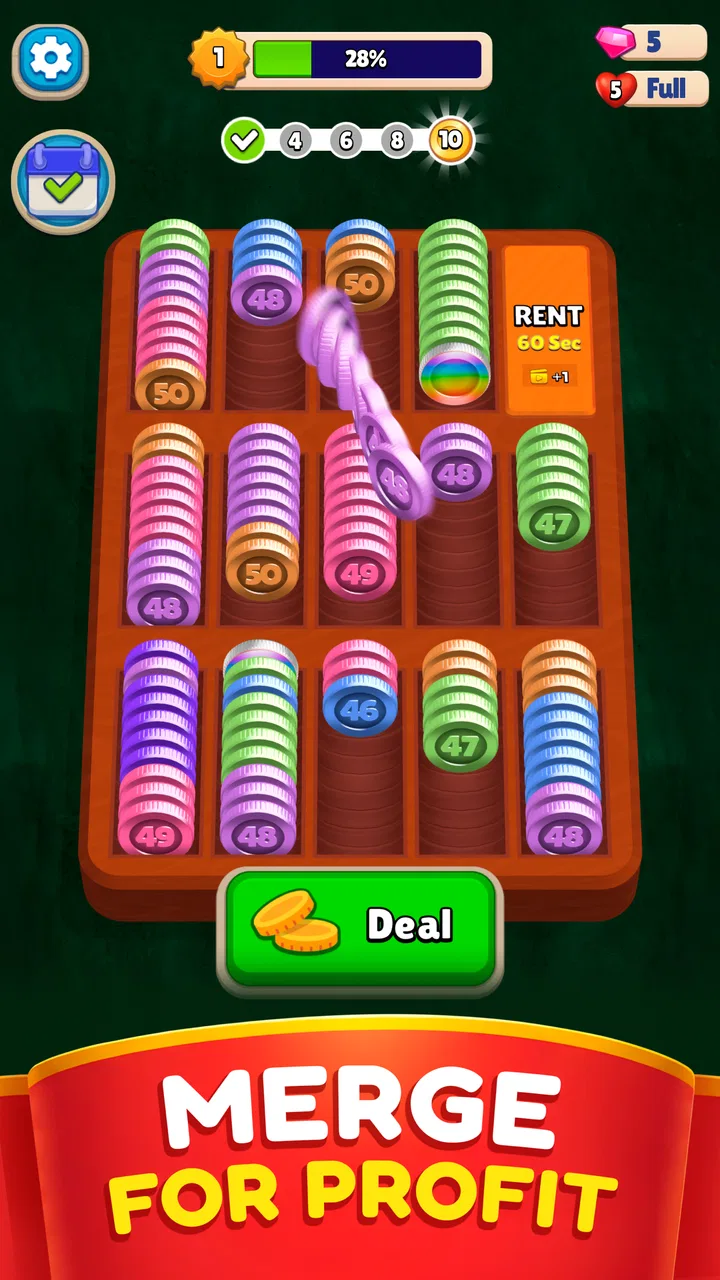
I spent time with Pocket Sort: Coin Merge Puzzle as a small, easy-to-start puzzle game, and my first impression was clear: this is designed for people who enjoy bringing disorder under control without learning a complicated rule set. The central activity is sorting and merging coins by color, so the appeal comes from watching a messy arrangement gradually become organized. It is the kind of game I can open for a short break, play with one hand, and understand almost immediately.
That simplicity is also the reason to approach it with the right expectations. This is not a story-driven adventure, a competitive multiplayer title, or a deep strategy game with a large collection of systems to master. It belongs firmly in the casual puzzle space. I found the best moments came from planning a few moves ahead, spotting where a color could be placed safely, and resisting the temptation to make the quickest move just because it looked available.
How Pocket Sort feels in its current form
The game’s identity is built around visual order. Coins are separated by color, and the player’s job is to arrange and merge them in a way that keeps the board manageable. That sounds straightforward, but sorting puzzles become interesting when one careless placement blocks a useful space or leaves a color stranded behind another group. The challenge is less about fast reactions and more about reading the board before committing.
You May Also Like

 Pandora - Music & Podcasts
Pandora’s Music Is Easy to Start, but Harder to Recover
Pandora’s strength is its low-effort path from a seed to a station. Its weak spot is how much confidence it asks you to place in connection, setup, and quiet recovery.

 8 Ball Pool
 Is Built on Rivalries, Rematches, and Routine
A close look at the rivalries, rematches, shared routines, and unanswered safety questions that turn a quick pool match into a persistent mobile community.

 Samsung Music
’s Quiet Strength Is Playing What You Already Own
Its reach comes less from spectacle than from dependable access to a personal library. That simplicity is both the app’s strongest retention engine and its ceiling.

 AccuWeather: Weather Radar
AccuWeather Review: A Quick, Clear Forecast for Everyday Decisions
For everyday plans, the best forecast is the one you can understand quickly. AccuWeather makes rain timing, radar, and local conditions easy to act on, with a few trade-offs.

 Hill Climb Racing
Why Hill Climb Racing Still Turns Crashes Into One More Run
A tiny car, a bumpy hill and one more upgrade: Hill Climb Racing keeps resurfacing because its simple chaos makes every near-miss feel personal.

 AliExpress - Shopping App
AliExpress Makes Global Shopping Feel Personal, but Shoppers Bear the Risk
AliExpress turns a global marketplace into a pocket-sized discovery engine. Its reach is useful, its shopping loop compelling, and its trade-offs easy to miss.
More From Our News Desk
View All News


I like that this format makes the game approachable for a wide range of players. The age rating is Everyone, and the basic goal is understandable without a long explanation. Someone who already enjoys sorting games will know what to do almost instantly, while a newcomer can learn through a few moves. The developer, SayGames Ltd, has chosen a concept that works particularly well on a phone because each decision can be made in a compact session.
In everyday use, I would put this in the same category as a game I keep available for waiting rooms, short commutes, or the few minutes before going to sleep. Imagine having five minutes before an appointment: this is more suitable than a game that demands a long uninterrupted run, because the sorting idea gets going quickly. At the same time, I would not recommend opening it when I want a rich narrative or a demanding tactical contest. Its strength is focused, repeatable puzzle play.
The visual logic matters more here than flashy presentation. When colors and coin groups are easy to distinguish, I can think about the next arrangement instead of decoding the screen. That clarity is especially valuable in a sorting game, where the entire puzzle depends on recognizing which pieces belong together. Players who find crowded interfaces tiring should still pay attention to how comfortable the board feels on their own device, but the concept itself is naturally readable.
The small decisions that make sorting satisfying
The most useful habit I developed was to avoid treating every open space as equally valuable. A free position may look convenient, but using it too early can remove the room needed for a more awkward color later. I started looking for the group that had the fewest safe destinations and planning around that first. This is a simple adjustment, yet it changes the game from random tapping into deliberate board management.
Another practical tip is to separate a color only when doing so creates a clear advantage. Moving a coin merely because it can move often produces a cleaner-looking board for a moment while making the next stage harder. I had better results when I asked whether the move would expose a useful coin, complete a group, or preserve an important empty position. That approach is more reliable than chasing immediate visual progress.
I also found that the order of operations matters more than the number of available moves. If two colors can be merged, the better choice may be the one that opens access to a blocked group rather than the one that completes the most obvious combination. This gives the otherwise gentle format a modest layer of foresight. It will not satisfy someone seeking a complex logic engine, but it is enough to make careless play feel noticeably different from thoughtful play.
For players who are new to this type of puzzle, I suggest using the first sessions to learn the board’s rhythm instead of trying to solve everything at maximum speed. Look at the full arrangement before moving, identify colors that are already close to completion, and keep at least one flexible space available whenever possible. These habits are more useful than memorizing a fixed sequence, because the value of a move depends on the current arrangement.
What the current release tells me about the game
The current version is 1.6.0, which places the game beyond its earliest release stage. Pocket Sort was released on September 5, 2025, and the version number suggests that SayGames Ltd has already moved through some early iteration rather than leaving the launch build untouched. I would not read that number as proof of a specific feature set, but it does make the present build the sensible one to evaluate instead of relying on first-release impressions.
For someone installing today, the practical point is that the experience should be judged as a developing casual game. A later version can reflect adjustments to balance, presentation, or general usability, but I would still separate what is visible now from what I hope future updates might bring. The game’s foundation is clear: sorting colored coins and merging them in a pocket-sized puzzle loop. Anything beyond that should be treated as a possible direction, not an established promise.
The technical entry point is also friendly. The minimum operating system is Android 8.0, so the game is not limited to only the newest phones. That matters for a casual title because many people will install it on a secondary, older, or budget device rather than on their main high-end handset. I would still judge smoothness and screen comfort personally, but the stated system requirement keeps the potential audience broad.
Its reach is already substantial for a new puzzle release: the game has passed one million installs, with an average rating of 4.5 from around thirty-two thousand ratings. Those figures do not tell me whether every player will enjoy the same pace, but they do indicate that the central idea has connected with a sizeable audience. There are also around six hundred fifty written reviews, which gives prospective players more room to compare individual experiences than a title with only a handful of comments.
How existing players may experience the update path
If you have been playing since the early release, the main benefit of staying current is straightforward: you are using the build the developer currently supports rather than an older snapshot. I would update before judging difficulty or overall polish, especially if an older installation feels rougher than what newer players describe. For a game this focused, even small changes to puzzle flow or interface clarity can affect how comfortable the whole loop feels.
New players, meanwhile, do not need to understand the game’s history to enjoy it. The current version works best as a clean entry point: learn the color relationships, practice preserving space, and gradually become more deliberate. I would not advise downloading an old build simply to compare versions unless you are specifically interested in the game’s evolution. The useful question for most people is whether the present sorting loop fits their habits.
The free price makes trying it easy, but free does not mean the experience is entirely without commercial considerations. In-app purchases range from $1.99 to $99.99 per item. That is a wide span, so I would approach optional spending carefully and decide in advance whether I want to play without purchases, make only a small occasional purchase, or avoid that model altogether. The game is easiest to recommend to someone who is comfortable treating purchases as optional rather than necessary.
My own advice is to play several sessions before spending anything. First find out whether the sorting decisions remain enjoyable after the initial novelty fades. Then consider whether a purchase solves a problem you genuinely have or simply encourages an impulse during a difficult board. This is particularly important for casual games, where the value of an item depends heavily on how often you return and how much the basic loop already satisfies you.
Where it works better than familiar alternatives
Compared with a traditional match-three puzzle, Pocket Sort asks for a different kind of attention. Match-three games usually reward spotting combinations within a changing field, while this game emphasizes placement order, available room, and grouping by color. I prefer Pocket Sort when I want a calmer puzzle that lets me inspect the situation before acting. I would choose a match-three alternative when I want faster visual reactions, more immediate chain effects, or a more energetic pace.
It also differs from classic tile-matching games that focus on making identical pieces disappear. Here, organization is part of the pleasure. The board gradually looks more controlled as the player makes sensible decisions, and that gives each move a practical purpose beyond simply increasing a score. If you enjoy arranging objects into categories, this may feel more natural than a game based on rapid combinations.
On the other hand, dedicated logic-puzzle apps may offer more varied rules, stronger long-term complexity, or a larger range of structured challenges. Pocket Sort is better for accessibility and quick entry, not for players who want every stage to introduce a radically new mechanic. I would choose a deeper logic title for a long weekend of concentrated problem-solving, but I would choose this one for a short, repeatable mental reset.
That distinction helps explain the game’s audience. It is a good fit for casual players who like order, colors, and gradual progress. It is less suitable for someone who needs a story, character development, online competition, or a large strategic toolkit to stay interested. The game does not need to become something else to be worthwhile, but its narrow focus means the right player matters more than the broad category label.
Limitations I noticed before recommending it
The same focused design that makes the game approachable can eventually feel repetitive. Sorting and merging colored coins is a clear hook, but players who need constant novelty may find the loop too contained. I would not install it expecting a broad collection of unrelated mini-games. Its value depends on whether repeating a familiar type of decision feels relaxing or monotonous to you.
The experience can also become less satisfying if you play without thinking about space. A poor sequence may leave the board feeling constrained, and that can make a session seem frustrating even though the rules are simple. My solution was to slow down, inspect the blocked colors, and treat empty positions as resources. Still, players who prefer puzzles with generous recovery options may find this style less forgiving than expected.
There is also a personal comfort question around the free-to-play structure. The game costs nothing to start, but the listed purchase range means some players will want to be deliberate about spending. If you dislike in-app purchase systems on principle, a one-time paid puzzle may be a better match. If you are comfortable with optional purchases and mainly want an accessible sorting game, the free entry point is more convenient.
Another limitation is that the game’s appeal is strongly visual and procedural. Players who rely on narrative motivation, character goals, or a sense of exploration may not find enough emotional variety here. I would recommend it to a friend who says, “I want something tidy and easy to understand,” but not to someone asking for a puzzle game with a memorable world or a substantial campaign.
Who should install it and what to watch next
I would recommend Pocket Sort to anyone who enjoys organizing objects, prefers short mobile sessions, and likes puzzles where planning beats reflexes. It is especially suitable for a player who wants a low-barrier game that can be learned quickly but still rewards looking ahead. The Everyone rating and Android 8.0 minimum also make it a practical option for households with a range of devices and ages.
I would skip it if you need deep strategic variety, competitive play, or a strong story to keep you engaged. I would also compare it with a paid puzzle game if avoiding in-app purchases is important to you. The free download makes experimentation sensible, but the right decision is to test whether the central sorting loop remains enjoyable after several sessions rather than assuming a strong rating guarantees a personal match.
Looking ahead, I would watch how SayGames Ltd develops the game without losing the clarity that makes it approachable. The most valuable evolution would be additions that deepen decision-making or improve long-term variety while keeping the coin-sorting idea easy to understand. I would be cautious about changes that make the board busier, the progression harder to read, or the purchase structure more central than the puzzle itself.
For current players, I would also pay attention to whether future versions improve the reasons to return after the basic routine becomes familiar. New layers could help, but they should support the core act of arranging and merging rather than distract from it. Since version 1.6.0 is the current reference point, I see the game as a promising, focused casual puzzle whose future will depend on how thoughtfully that foundation is expanded.
My final view is positive but specific: Pocket Sort: Coin Merge Puzzle is worth trying if controlled, color-based sorting sounds satisfying to you. I enjoyed the way a few careful choices could turn a cluttered board into a clear one, and I appreciated that the game does not demand a large time commitment. It is not the most varied puzzle experience, and its purchase model deserves attention, but as a free, compact sorting game from SayGames Ltd, it has a clear purpose and delivers that purpose well.
FAQs for Pocket Sort: Coin Merge Puzzle
01What is the main objective of Pocket Sort: Coin Merge Puzzle?
Pocket Sort: Coin Merge Puzzle is a casual puzzle game where the main objective is to sort and merge coins to achieve higher denominations. Players must strategically combine coins by dragging and dropping them into slots, aiming to clear levels and set high scores through efficient merging techniques.
02Is Pocket Sort: Coin Merge Puzzle free to play?
Yes, Pocket Sort: Coin Merge Puzzle is free to download and play. However, the game includes in-app purchases that allow players to buy additional coins, hints, or other special items to enhance gameplay. Players can enjoy the core game without spending money, but optional purchases can provide a smoother experience.
03Are there any ads in Pocket Sort: Coin Merge Puzzle?
Yes, the game contains ads that may appear between levels or when accessing certain features. These ads help support the developers and keep the game free. Players can often choose to watch ads voluntarily to earn extra coins or bonuses. There may also be an option to remove ads through an in-app purchase.
04What are the key features of Pocket Sort: Coin Merge Puzzle?
Pocket Sort: Coin Merge Puzzle offers a variety of features, including intuitive drag-and-drop controls, multiple challenging levels, and visually appealing graphics. The game also provides daily challenges and rewards, leaderboards for competitive play, and regular updates with new content to keep players engaged.
05Is Pocket Sort: Coin Merge Puzzle suitable for all ages?
Yes, the game is designed to be family-friendly and suitable for players of all ages. Its simple mechanics and colorful interface appeal to both young children and adults. While the game is easy to learn, it offers enough complexity and challenge to keep older players interested. Parental guidance is advised for in-app purchases.
Pros
- Engaging and addictive gameplay.
- Simple mechanics
- easy to learn.
- Great for improving focus.
- Visually appealing graphics.
- No intrusive ads during play.
Cons
- Limited levels can get repetitive.
- No offline mode available.
- In-app purchases can be pricey.
- Occasional lag on older devices.
- Lacks multiplayer features.

Pocket Sort: Coin Merge Puzzle
Gallery